
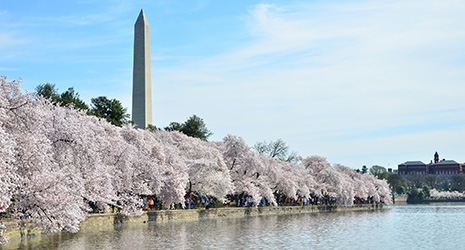
今ワシントンD.C.のポトマック川の五色桜は満開です。もともと五色桜は、現在の東京都足立区の荒川堤に植えられていた桜の総称です。明治時代、ソメイヨシノだけでなく、多種多様な里桜が約78種類も植えられ、その多様な色彩から「荒川の五色桜」として世界的に有名になりました。1912年に日本からワシントンD.C.へ贈られた3,000本の桜の多くは、この荒川堤の苗木から育てられたものでした。
しかし、本家である日本の五色桜は、その後の不幸な歴史によって絶滅の危機に瀕します。その理由は、工場の排煙や都市開発による環境悪化、荒川の改修工事に伴う伐採、そして第二次世界大戦による被害によります。これにより、東京の五色桜はほとんどが失われてしまいました。
戦後、かつての美しい五色桜を復活させようという動きが日本で起こりましたが、すでに日本国内には元々の品種が揃っていませんでした。そこで、ワシントンに贈った桜が、当時の血統を保ったまま元気に育っていることに着目し、ワシントンから枝を分けてもらうことになったのです。1952年に荒川堤の改修を機に、初めてワシントンから枝が贈られました。1981年には「レーガン桜」として、さらに大規模な里帰りが行われ、足立区などに植樹されました。
真珠湾攻撃後の戦時中、ワシントンでは日本への敵対心から桜が数本切り倒される事件が起きました。さらに「桜をすべて引き抜いてしまえ」という過激な意見も出たといいます。しかし、多くのアメリカ市民や関係者が「木に罪はない」「この桜は平和と友情の象徴である」として、桜を守り抜きました。戦時中は「日本の桜」と呼ぶ代わりに「東洋の桜」と呼び方を変えるなどの工夫をして、この美しい景観が維持されたのです。
The Goshikizakura (five-colored cherry blossoms) along the Potomac River in Washington D.C. are in full bloom. Originally, Goshikizakura was a general term for cherry trees planted along the Arakawa River embankment in what is now Adachi Ward, Tokyo. During the Meiji era, not only Somei Yoshino cherry trees but also approximately 78 varieties of other diverse village cherry trees were planted, and their diverse colors made them world-famous as “Arakawa’s Goshikizakura.” Many of the 3,000 cherry trees gifted from Japan to Washington D.C. in 1912 were grown from saplings along this Arakawa River embankment.
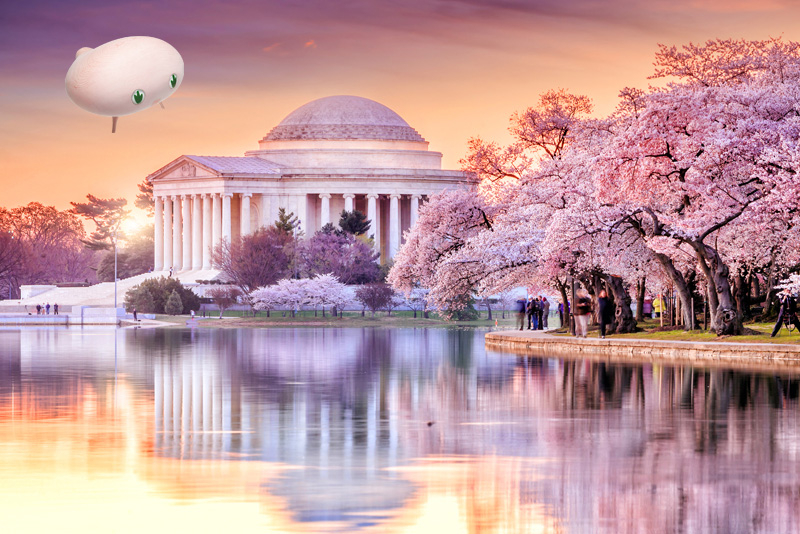
However, the original Goshikizakura in Japan faced extinction due to unfortunate circumstances. These included environmental degradation from factory emissions and urban development, felling during Arakawa River improvement work, and damage from World War II. As a result, almost all of Tokyo’s Goshikizakura were lost.
After the war, there was a movement in Japan to revive the beautiful Goshikizakura of yesteryear, but the original varieties were no longer available within Japan. Therefore, noticing that the cherry trees gifted to Washington were still thriving while maintaining their original lineage, it was decided to request branches from Washington. In 1952, during the renovation of the Arakawa River embankment, the first branches were gifted from Washington. In 1981, a larger-scale return of the trees, known as “Reagan Cherry Trees,” took place, with trees being planted in Adachi Ward and other areas.
During the war after the attack on Pearl Harbor, several cherry trees were cut down in Washington due to hostility towards Japan. There were even extreme calls to “uproot all the cherry trees.” However, many American citizens and those involved protected the trees, stating that “the trees are innocent” and “these cherry trees are symbols of peace and friendship.” During the war, efforts were made to preserve this beautiful landscape, such as changing the name from “Japanese cherry trees” to “Oriental cherry trees.”
総合的な教育支援の広場

コメントを残す